Well, if ISIS and ebola are not enough, here is a killer that is staring you in the face RIGHT NOW! Harvard Medical School claims that blue light, the light emitted by your computer, disturbs your ability to sleep, and contributes to the causation of cancer, diabetes, heart disease, and obesity.
What you can do to keep these symptoms at bay:
Use dim red lights for night lights. Red light has the least power to shift circadian rhythm and suppress melatonin.
Avoid looking at bright screens beginning two to three hours before bed.
If you work a night shift or use a lot of electronic devices at night, consider wearing blue-blocking glasses.
Expose yourself to lots of bright light during the day, which will boost your ability to sleep at night, as well as your mood and alertness during daylight.
There is also https://justgetflux.com/. After sunset it changes your monitor to a redder, more natural temperature.
Thursday, October 09, 2014

Tuesday, September 30, 2014
news
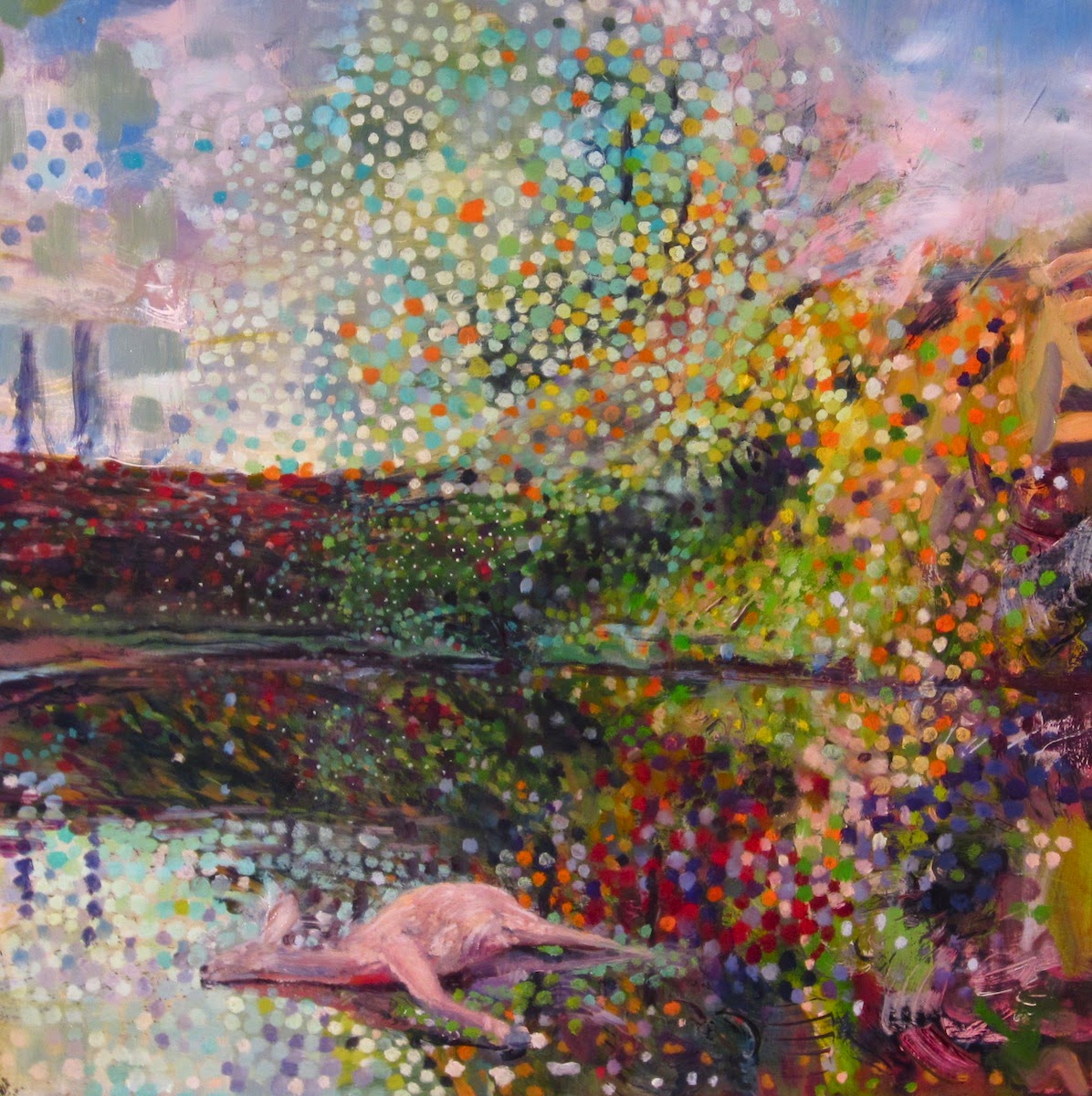
SBTRKT, one of my favorite composers, just came out with a new album you can listen to for free here. Also, I sold a painting! "Flesh of the World" sold to composer Chuck Wild, creator of Liquid Mind and old friend of my parents. What an honor!




Tuesday, September 02, 2014
Tuesday, August 26, 2014
Eli


Monday, August 25, 2014
American Tragety Sites
Some landscapes are celebrated as sacred
sites because of the stories that are told about them, whereas others are
marked as horrific sites of tragedy, humiliation, and cultural shame. To the
uninformed eye, both places look the same—expansive, hilly, idyllic—which
attests to the notion that every landscape is not just a physical place, but is
also what theologian Belden Lane calls a “storied place.”
For American Tragedy Sites, first I
research the historic place, and then I sketch, take photographs, and paint it.
I finish the composition in my studio by mixing the rendered landscape with a
totem of other symbols and nonobjective spaces.
Through the languages of realist landscape painting and
religious icon-painting, I aim to honor these shadowed lands as holy lands, and
to disturb conventional distinctions between what is sacred and what is
shameful.
I believe certain landscapes offer insight into how we
grapple with tragedy. Some sites of cultural shame are hidden away, avoided, or
“obliterated,” to use geographer Kenneth Foote’s term. These sorrow-filled
sites can get lost often by hiding in plain sight. For example, guests can pass
through the old Hyatt Hotel lobby in Kansas City, drink coffee and mingle, and
never know about the event that happened there in 1981—”the worst structural
disaster in American history!” There is no plaque, no memorial, no spot to lay
flowers or light candles. The historic event, then, is more easily
forgotten.
This intentional oversight or forgetting happens all the
time. If the memory attached to the site is too painful, or too shaming,
the culture will attempt to erase it by re-landscaping or by destroying
records. Salem, for example, kept no official record of the small hill where
nineteen victims of the witchcraft scare were executed, so today its exact
location is unknown. Likewise, the fence where Matthew Shepard was killed in
Laramie, Wyoming, was promptly removed and the street names were changed to
confuse tourists (“Out of sight, out of mind”). In both cases, the true
location of the historic event lives on only in hearsay.
But now we have GPS, and landscapes push back, and people
get behind them and lobby to have them preserved. The Minidoka Japanese
Internment Camp site in south central Idaho, a true national shame site, was
converted into farmland and torn down as quickly as it was constructed. But
activists got funding and rebuilt its barbed-wire fence and ominous watchtower,
two important communicators of the daily psychological experience of the
Japanese-Americans imprisoned there during WWII. A few other elements of the
Minidoka landscape remain: Fujitaro Kubota’s eerie rock garden, dusty
labyrinthian pathways, the scorching sun, rushing river, and desert indifference.
If for some reason the actual tragedy site is truly lost or
inaccessible, a culture will construct a miniature version, a memorial across
the street. In the case of Matthew Shepard’s memorial, it is a bench at the
university miles away. But there are also memorial gardens, parks, museums, and
trees! There are memorial trees, like the prayer tree in the center of the
killing fields of the Bear River Massacre site, probably the greatest forgotten
Indian massacre in American military history. “The first and the worst,”
and it’s also easily one of the most beautiful landscapes and memorials I have
ever seen. The place is woven into a wide river valley in the foothills of the
Rockies, swarming with wildlife, flowers, and hot springs (the Shoshoni vacationed
there every winter). The tree is somewhat hidden next to others behind the
official, unimpressive, monolithic memorial standing in a gravel parking lot
next to a trash can. The tree’s lower half is covered in freshly made dream
catchers, medicine bundles, stuffed animals, beaded necklaces, colored flags,
and gem stones. Buckets full of toys and chewing tobacco hang from branches
near the trunk.
Every January the surviving Shoshoni and others gather at
the tree, refresh the offerings, and pray that the Warm Dance will happen again
one day.
Thursday, August 14, 2014



Monday, August 11, 2014
Wednesday, August 06, 2014


Friday, July 11, 2014
Ephemera

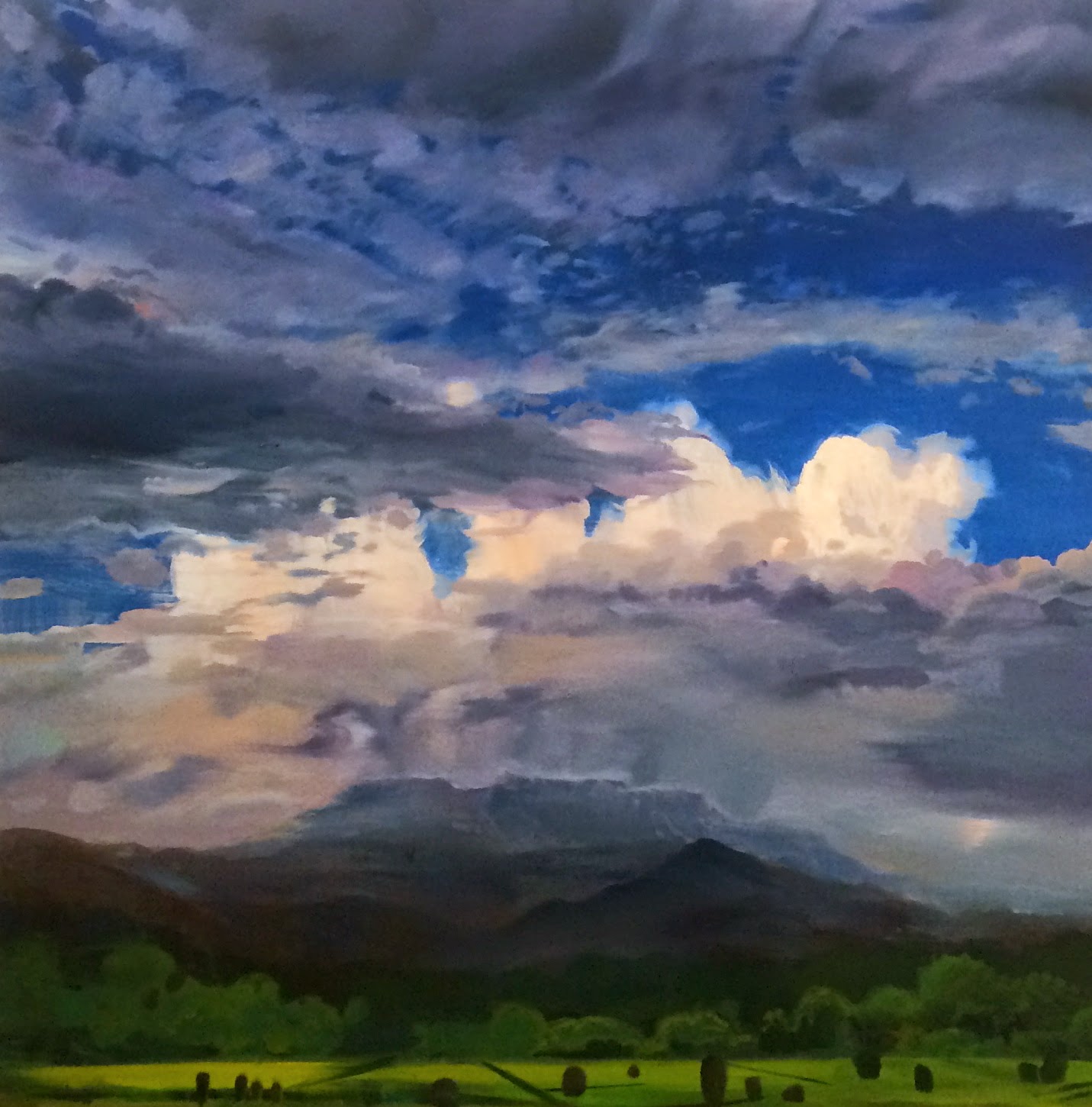
This painting won 2nd place in the River Market Regional Exhibition! Check out the online catalogue.
The head curator from the Nelson-Atkins museum of Art was the judge. I feel good.
"Titterington’s series of sky paintings are intended to “bring the sky down, and to highlight the ever-present source of light and weather. When we open our eyes, sky provides the space and the light for seeing. Sky is openness or transparency itself, sheer luminosity. It is nature’s most elusive realm, and it provides a great metaphor for the self. As Rilke says, our inner lives are, for the most part, intensified skies.” "
Wednesday, May 28, 2014
Happy Birthday Kyle
It's all in your brain.
Scientists have found that dogs across a variety of breeds align their body axis with the Earth's magnetic field before squatting to poop. "Our analysis of the raw data ... indicates that dogs not only prefer north-south direction, but at the same time they also avoid east-west direction. It is unclear why the dogs find the planet's north-south axis more comforting."


Subscribe to:
Posts (Atom)