Saturday, August 24, 2013

race and a cyborg

 Reflections on white privilege and racism against Asians in hollywood and TV.


Breakfast with Google Glass, Cat, Chad and Michael. 

Monday, August 19, 2013

randoms

four year old niece: "I want to be three again!" 
me: "I'm sorry but you can't be three again. You can only grow up!=)"
niece: "OH NO!!!!," starts screaming and crying.


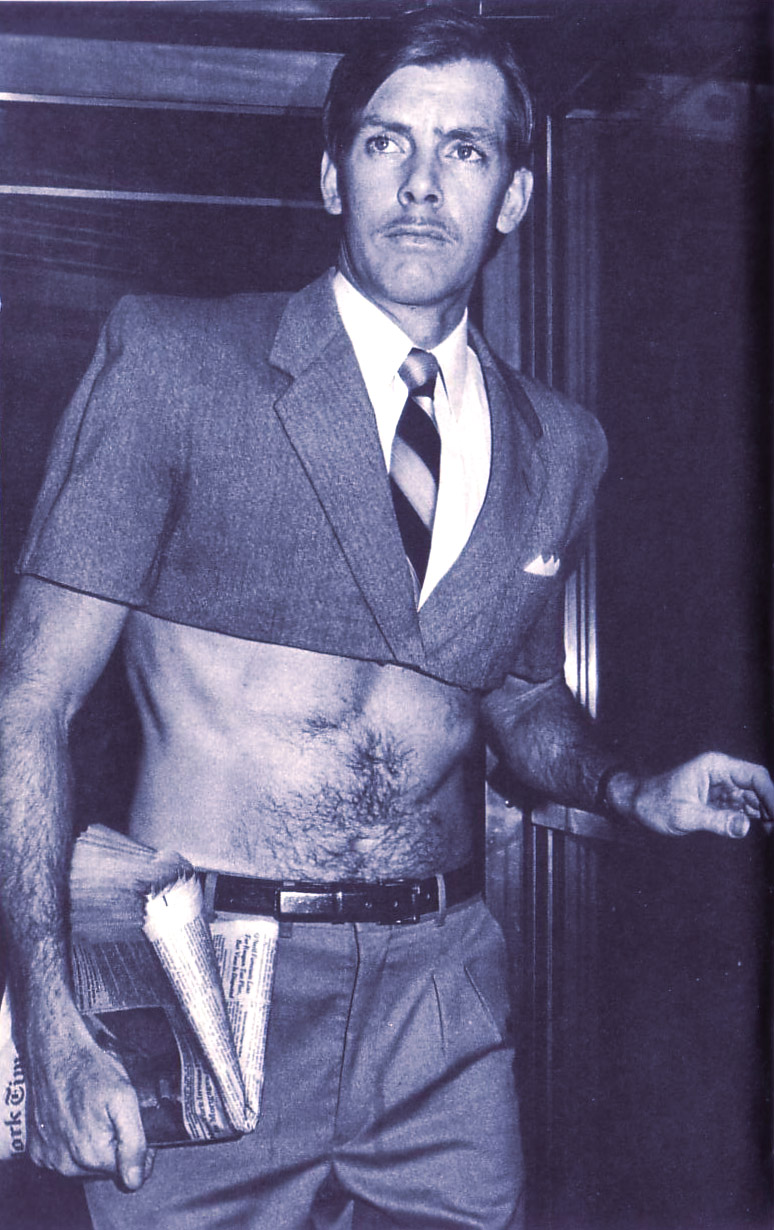
"Why is ‘the suit’ or ‘corporate uniform’ so important for managers? I suggest that it is because the highly tailored, dark-coloured (often black, dark grey or navy) business suits function to seal the bodies of men and women managers. Firm, straight lines and starched creases give the appearance of a body that is impervious to outside penetration...Business suits not only give the impression of a body that is impervious to outside penetration but also of a body that is impervious to the dangers and threats of matter that is inside the body making its way to the outside. It is considered inappropriate for matter to make its way from the inside to the outside of bodies (for example, farting, burping, urinating, spitting, dribbling, sneezing, coughing, having a ‘runny nose’, crying and sweating) in most inner city workplaces. This observation about people wearing business suits avoiding farting, burping and so on in public almost seems too banal to mention. The performative (Butler 1997) takes on the appearance of the natural. Phillip Garner (1983: 30) destabilizes this naturalness in his comic photograph of the ‘half-suit’...."The suit helps to create an illusion of a hard, or at least a firm and ‘proper’, body that is autonomous, in control, rational and masculine. It gives the impression that bodily boundaries continually remain intact and reduce potential embarrassment caused by any kind of leakage. When bodies are draped in soft, light fabrics it is often possible to see the boundaries of the body – the rise and fall of the chest, mound of the breast, contour of the muscle. It is possible to see a spot of blood, a smear of dirt, a piece of flesh. Such matter signifies a body that cannot be neatly contained, a body that is not always rational and in control, a body that is both desirable and disgusting." 


Theweleit (1987) discusses some of ways in which young boy’s bodies (through the military academy) are reconstructed into soldiers’ bodies: the boy becomes ‘a man with machine-like periphery, whose interior has lost its meaning’.


Saturday, August 10, 2013

Handfasting


It was an honor to officiate Whitney and Jennifer’s Handfasting Ceremony last night! Here is my outline for those of you interested. 

"Greetings sisters, brothers, family, friends and guests.
We gather here on this beautiful day in this magnificent place to celebrate the handfasting of Jennifer Wilson and Whitney Hutsell.

I’m sure you know it is an HONOR to be here as a witness to your handfasting ceremony. I am not alone when I say that you two are gifts to our lives, and you are the proof that this universe is divine.


HISTORY

For those of you who don't know, Handfasting is the traditional ceremony that lead to the expression “tying the knot” to mean marriage. It became popular in medieval Europe, when people wanted to get married but did not have access to a priest. For handfasting, all they needed was a witness, someone to tie the knots, and for a cosmic element they looked to the biblical truism found in Matthew 18:20, when the voice of the highest love and mystery says: “When 2 or 3 gather in my name, There I am in their midst.” Well. Here we are, 3 or more of us, and we are all gathered here in the name of Love. Shall we begin?

To get us in the mood, I will read a poem that you both chose for this occasion.

I love you
not only for what you are,
But for what I am
when I am with you.

I love you, Not only for what
you have made of yourself,

But for what
you are making of me.


I love you

For the part of me
that you bring out;


I love you
For putting your hand
into my heaped-up heart

And passing over
all the foolish, weak things

That you can't help dimly seeing there,

And for drawing out
into the light

All the beautiful belongings
that no one else had looked

Quite far enough to find


I love you Because you
are helping me to make
of the lumber of my life
Not a tavern,
but a temple.

Out of the works
of my every day

Not a reproach,
but a song.


I love you
Because you have done

More than any creed
could have done

To make me good.
 And more than any fate
could have done

To make me happy.
You have done it

Without a touch,
Without a word,
Without a sign.

You have done it
by being yourself.

The large energizes the little as the atmosphere energizes the flame. Therefore, as one, large body, let us all rise. If you cannot rise with your body, rise with your mind. Open and relax your hands and face them towards the couple.

Now our bodies are synchronized. To sync up our minds, lets all think about Whitney and Jennifer. Just think about their kindness, their relationship to you, their love for each other and for their friends and family.

Now that we are all in love and our minds are in relative synchrony, as one voice, let’s repeat the sacred prayer three times and affirm our commitment to this couple.

Whitney and Jennifer,
Thank you
thank you
thank you.
We see you, we love you, we support you.

You may sit.

Together, our witnessing awareness will energize and consecrate your commitment to each other as we now listen to your vows and watch you exchange rings.

VOWS

You have made your vows, one to the other, before your largest and highest selves. Now we are ready to complete the handfasting.  Each family member will announce their hopes for your marriage and then tie their ribbon around your hands.

HANDFASTING

Imagine that woven into these cords, imbued into the fibers, are all the hopes of your friends and family, and of yourselves, for your new life together.
Now, kiss your first kiss as a married couple, and celebrate this union for the rest of your lives!


Friday, August 02, 2013


Friday, July 12, 2013

Brush Creek Ranch

I am the luckiest boy on earth! Here are a couple pictures of the ranch by photography professor Dan Larkin, who works in the studio next to mine. Five out of the eight of us are professors. Conversations around the dinner table and campfire are incredible. Charles Nichols, a composer, lived in Matsumoto with Suzuki sensei when he was younger, studying violin, and he is currently reading Sheldrake's new book Science Set Free, which, for those of you in the know, means he's awsome.  Marie Dorsey is half Japanese and we practice speaking nihongo all the time.  She looks and acts just like Mrs. Yanagi, my Japanese mother. Samantha Schaefer is a jazz vocalist and poet, and owns every Bobby Mcferrin album. We like to sing circle songs together.


The tiny neighboring town of Saratoga has a hot spring open 24 hours a day that we visited last night. All kinds of people from the community were there. Next to the hot spring is a drive through liquor store/taxidermy shop. I'll post more pics asap! 

Monday, July 08, 2013

Japanese pearly white identities: Semen, Bukkake, Bodylore

I'm researching the materially of semen in Asia and so far I’ve found out some fascinating connections between semen, ancestry, rice, whiteness, and consciousness.

I begin with Japanese anthropologist Ohnuki-Tierney's impressive Rice as Self, where she charts the many ways white rice stands for the purity and superiority of the Japanese race, the pearly radiance of the skin, the positive energy of deities, money, and the origin of semen and breast milk. She also reminds us how each grain of rice is considered within Shintoism an individual spirit whose consumption rejuvenates humans and gives them a soul. 

Jump to our own tradition: Revelation 21:21: “The twelve gates were twelve pearls, each gate made of a single pearl!” In the 2008 remake of The Day The Earth Stood Still, pearly sphere-gates come out of the ground and, like semen, carry life to its new home. Considering liquids are naturally spherical, pearls appear like drops of semen. Could the materiality of this important fluid influence such revelatory images in our myths and in our popular science fiction? 


Scientific literature and cultural perceptions revealing semen as dangerous, disgusting and dirty are fairly new. When we relax our imaginations and look to our own rituals and to mythologies about semen, we can see how the materiality of the substance becomes a conceptual ground for images of purity, soul, self, and even community. As Janet Carsten (2004) makes clear, concepts of kinship are linked to substances of the body, such as blood, milk, and semen. These become metaphors for unity and sameness.  Semen’s pearly, white, milky, oily, flowing materiality, explains Victor Turner, help it signify achievement, wholeness, flow , self worth, and communitas. Turner argues that within an ethnic identity, homogeneity is sought instead of heterogeneity. “The members of the community are to be regarded, at least in rite and symbol, a unit...seamless...purified from divisiveness and plurality.” Japanese identity centers on white rice not only because it is a staple food and we "are what we eat," but also because of its uniform whiteness. Sentgen (2010) points out that “the most important phenomenological characteristic of substances is the fact that they can be divided without losing their identity.” Rice concretize abstract ideas like ‘imagined communities’, and anchors subjective, imagined relationships in a shared, material substance. Without objects such as rice, the Japanese experience and shared identity would be “as airy as the wind,” as  Michael Serres puts it. “In fact, the objects…stabilize our relationships.” 

The most important characteristics of Japanese rice are its qualities of luster, purity, and whiteness. Tanizaki Junichiro, in his influential novel In Praise of Shadows, explains the beauty of rice succinctly: “Each grain is a pearl.” This is not just an aesthetic pronouncement. For example, in the past rice was used as money in Japan, and rice fields meant status for Lords. The term for cooked rice, gohan, can stand for all food, as bread can stand for all food and money in English. Rice-wine, nihonshu, “Japanese liquor,” remains the staple drink in rituals and ceremonies. At a wedding, rice wine is drunk to consecrate the marriage as white rice is thrown at brides here in America as white bread is placed in the mouths of Christians during communion.


The Japanese origin myths of rice are also quite fascinating. In one, the deity in charge of food is ritually slain and various grains came out of his corpse: “rice emerged from his abdomen, millet from his eyes, and wheat and beans from his anus…”  The eyes, mouth, and anus are all important places in Japanese bodylore, but the abdomen, which houses the fetus, is believed to be the home of the soul. This is why hara-kiri, “stomach cutting,” is the well-known cultural institution of male suicide. Opening the stomach releases the soul.  


Interestingly, within Shinto cosmology, rice is the only grain given a soul. Each grain of rice is a kami named Uka no Mitama no Kami, a spirit-force supporting material life. Unlike most kami who possess both positive and destructive attributes, rice kami are completely innocent, unable to do harm.


After further creations and kami appear, the gods dispatch a grandson, Ninigi-no-Mikoto, to be the first Man to receive the rice and rule Japan with his decedents. The great grandson of Ninigi-no-Mikoto, called Jinmu, was enthroned as the first emperor of Japan, and the imperial sovereignty has to this day remained in the dynasty established by Jinmu some two thousand or more years ago. Japan did not have a Warrior King tradition. The shogun were the warriors. The Emperor was, "the guardian of rice-plants." According to many Japanese historians, the key role of the dynasty is to enact the Onamesai, a rice harvest ritual. Part of the secret ceremony involves the emperor lying on a bed and two women "receive the emperor's soul that is departing from his body and renew it."


This official Shinto story was influenced by the Buddhist one, which had been in Japan for well over two centuries. Within esoteric Buddhism, semen is definitely not just seminal fluid: it is the “vital essence-drop that is spread throughout the body in numerous subtle channels as the supports of life and consciousness.”


In the secret Tachikawa school of Shingon Buddhism, sex is holy, and a student eats his master’s semen as a means for mind-to-mind transmission. Epiphanius, the great Church Father, reports that an early Christian group, the Borborites, also practiced eating semen as a Eucharistic ritual. Like the Shingon Buddhists, they understood semen and menses to be “The Body and The Blood of Christ.” Phenomenologically, these fluids carried with them states of joy, shame, shamelessness, community, and revelation. Here we should be reminded of Raymond Kelly’s discussion of the Etoro people of Papua New Guinea, where boys ingest the elder’s semen, or “penis-oil,” as a rite into adulthood and a way to receive the mind-lineage of the tribe.


In Buddhism, semen is believed to exist in both men and women, metaphorically related to bodhicitta, meaning ‘mind of enlightenment.” In Tibetan, semen is called tigle, meaning literally ‘dot’ or ‘essence.’ Translator Keith Dowman elaborates that refined semen is “stored in the heart center as “radiance”, which produces long-life and gives a shine to the complexion. Unrefined semen is excreted during sexual intercourse and is, of course, procreative seed. The refined semen in the heart center permeates the body as Awareness; “heart center” is here a metaphor for the all-pervasive sphere of essential being (dharmakaya). Loss of semen, by any means, causes life-span to be shortened and causes a pallid complexion.” Clifford: “The brightness and radiance of the face is said to come from the essence of “semen” at the heart…From the years one to twelve the essence of “semen” supports the growth of the body. From twelve to fifty it goes to strength, or during pregnancy, to the breasts for milk. From fifty to one-hundred it goes to maintenance of the body.” 


For the male tantric practitioner of any lineage, withholding semen during real and/or imagined sex is a crucial aspect of spiritual practice. The seventh Dalai Lama describes the feeling:
        
         “The outer consort, in nature fire, melts the life-drops that course through the seventy-two thousand channels,  bringing them into the central channel, giving rise to the four ineffable joys.         Outside, all sensory movement of mind and energy ceases…”

In the Tibetan Book of the Dead, semen is used as a metaphor for Vairochana, the Originator of all phenomena, the Cause of all Causes. “As the Universal Father, Vairochana manifests or spreads forth as seed, or semen, all things; his Shakti, the Mother of Great Space, is the Universal Womb into which the seed falls and evolves as the world-systems.”

In Buddhism, we personally experience the eternal “Clear Light Mind” for a brief second at the moment of orgasm. Semen is thus not only a symbol for this mind, but also a physical incarnation of it. Japan is where this esoteric Buddhist view of semen mixes with the shamanic Shinto one of rice.

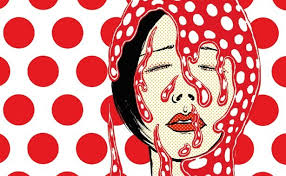
Beloved Japanese pop artist Yayoi Kusama uses white polka-dots in her important 1967 film “Self-Obliteration.” 


To better understand how a substance from the body can be so closely related to a substance from the earth, we can look to Etoro’s neighboring tribe, the Bimin-Kuskusmin of Papua New Guinea. They relate semen to oil that comes out of a sacred hole in the forest. This oil makes the entire forest a realm of immense ritual importance and spiritual power linking the living with the dead and humans with spiritual entities. Their bodies are understood in terms of the semen-oil produced by the god, Afek. Tilley reports: “Oil-soaked taro is fed to domestic boars, bamboo tubes of oil are buried to promote the growth of taro, and oil is rubbed on the skin to make it glisten and ensure personal well-being. Shrines throughout the forest are anointed with oil. Oil is conceived to flow under the landscape itself in the realm of the spirit world.” The tribe’s leaders talk of oil as “our blood, our semen, our bone, our heritage from our ancestors…our life.” Oil is to the Bimin-Kuskusmin as rice is to the Japanese.


In Japan, semen is also associated with chthonic forces and mythic origins of the world. According to the most ancient Shinto text, the Kojiki, (A.D. 712), ancestors of all creation, Izanagi and Izanami, Sky-father and Earth-mother thrust down a gifted “heavenly jewel-spear” into the “oily” ocean of chaos. They move it around, pull it out, and drops from the spear’s tip become the onogoro, “self-hardening,” islands of “luxuriant reed-plain-land-of-fresh-rice.” The sexual overtones are obvious, as are the geological, volcanic ones. Vannovsky’s interpretation of the Kojiki, Volcanoes and the Sun argues the mythical penis spewing forth self-hardening semen should be understood as volcano spewing forth magma.


I find it interesting that until recently it was illegal under Japanese law to publish images of human genitals, anuses, and/or pubic hair. Semen, however, could be shown. It is celebrated in anime porn and the recently established bukkake porn. Bukkake, meaning "splash", is a Japanese pornographic invention, usually consisting of a group of men ejaculating together onto someone's face in the center. The pornographic trend has since spread to other countries. 


Reviewing the way Indian religions view semen gives it another possible shape. Swami Narayanananda teaches that within Hinduism, “semen exists in a subtle form all over the body. By sexual desires, thoughts and acts, the gross semen is formed.”  As yogis we are to convert heavy (gross) semen into subtle semen, called shakti, and then keep it from congealing back down through the use of pranayama and seminal retention. In Play of Consciousness, Swami Muktananda compares this important body technique to saving money. “You should preserve your seminal fluid, which is your radiance, as you save money, watching every penny. Never forget that a radiant human being can be formed from that one drop. If you loose it, all the best powders and creams and rouges and lipsticks will not brighten your skin. The radiance of the sexual fluid is the vehicle of Chiti Shakti. Chiti is, as it were, bought with it. It is the means for activating the Kundalini and the highest means of making Samadhi stable. Look carefully and see the condition of the man who has wasted his sexual fluid.” 


Japanese people love shirako, fish semen. The milt resembles human semen. 


 Semen is also the material beginnings of the mythical substance amrita, said to leak down into the yogi’s body via the pineal gland. This “nectar of the gods” is understood in relation to the shakti which rises from the sacrem (the sacred) like a snake up the spine to be transformed into bliss upon entering the brain like semen entering the vagina. Some Vedic philosophers argue amrita is just a symbol for cerebral-spinal fluid. Nevertheless, yogis report amrita is generated by retaining their semen during intercourse, real or imagined. This personal mythology manifests collectively as the most sacred and expansive of all Hindu festivals, the Kumbh Mela, centered around the group obtaining amrita from the Heavenly Ocean of Milk. In Bengal, amrita is specifically understood as Shiva’s semen. The Kumbh Mela is therefore the world’s largest spiritual bukkake scene.


In Indian history there are references to sacrifices of semen becoming an alternative to human sacrifices. This is because the semen is the soul. The female ovum is believed to be the source of blood, meat, and bones, whereas semen is the source of the soul, vital breath, and marrow. David White notes that within Indian culture semen is called saumya (lunar) and is also understood as Soma, the moon deity. This helps the culture connect microcosmic semen to macrocosmic moon. 

Purhapse within a Japanese man the materiality of semen touches the cultural acceptance and celebration of rice-sharing. The “okuizome“ ceremony marks the moment the child, now 100 days old, can eat rice instead of milk. Milky warm rice-wine is drunk by the adults. Soft, white sticky rice-cakes, mochi, are consumed by everyone, offered to every shrine, and made by men coming together in group ritual. Sometimes at new years people get together and drink rice gruel and rice spirits. Every year it’s not uncommon for the sticky ricecake soup, zoni, to kill several old people by sticking to their throats.


Murakami: Lonesome Cowboy (1998)

A perfect bowl of rice may recall images of balls filled with semen. The word for ball, tama, is the same as the word for soul. At funerals, chopsticks are pushed into a heaping bowl of rice and left erect and phallic, further suggesting the rice-semen-testicle complex. The daily offering to the family ancestral alcove continues to be rice, and the rice reeds are still woven together to create shimenawa holy ropes that sacralize houses, temples, trees, stones, and sumo wrestlers, transforming them into places for kami. Shide, white rice-paper lightning bolts zig-zag from the thick ropes and might as well symbolise semen. Now we can see bukkake above every temple doorway, and the sumo wrestler is a version of Murakami’s Lonesome Cowboy. Moreover, the ritual magic wand used by all Shinto Priests, the onusa, is a wooden pole with a bunch of white shide hanging from its tip, sparkling in the sunlight.


May all beings be Free and in Love.


Blog Archive